PHOTONFLAME replaces the spark plug with a laser, delivering more power, cleaner combustion, and an ignition system with nothing left to wear out. We're proving it in motorsports first, then bringing it to industrial engines, aerospace, and the vehicles on the road today.
3
Non-Provisional Patent Filings
<1ms
Target Ignition Latency
10–15%
Efficiency Gain Potential
$187B+
Total Addressable Market
For more than 100 years, spark plug technology has barely changed. It’s imprecise and inefficient, and it holds back performance, emissions, and engine intelligence. That means wasted fuel, lost power efficiency, and increased maintenance costs compared to photonic ignition.
Up to 15%
Fuel wasted due to inefficient combustion
Up to 30%
Higher real-world emissions from inconsistent ignition
Up to 10%
Power lost to ignition variability and misfires
Ongoing
Maintenance cost from plug replacement and downtime
Illustrative figures based on management’s internal engineering analysis of conventional spark-ignition performance under representative operating conditions. Actual results will vary by application and are not a guarantee of PHOTONFLAME’s future performance.
A traditional spark plug erodes every time it fires: the gap widens, fouls, and eventually fails. PHOTONFLAME replaces that gap with a laser, so there's no electrode to wear down and no part to replace over the life of the engine.
Because ignition is controlled by software instead of a fixed piece of metal, it can be tuned in real time to how an engine is actually running, unlocking more complete combustion, more usable power, and less fuel burned for the same output.
High-pressure conditions, lean fuel mixtures, and extreme environments are where conventional spark plugs misfire most often. PHOTONFLAME is designed to stay consistent precisely where traditional ignition breaks down.
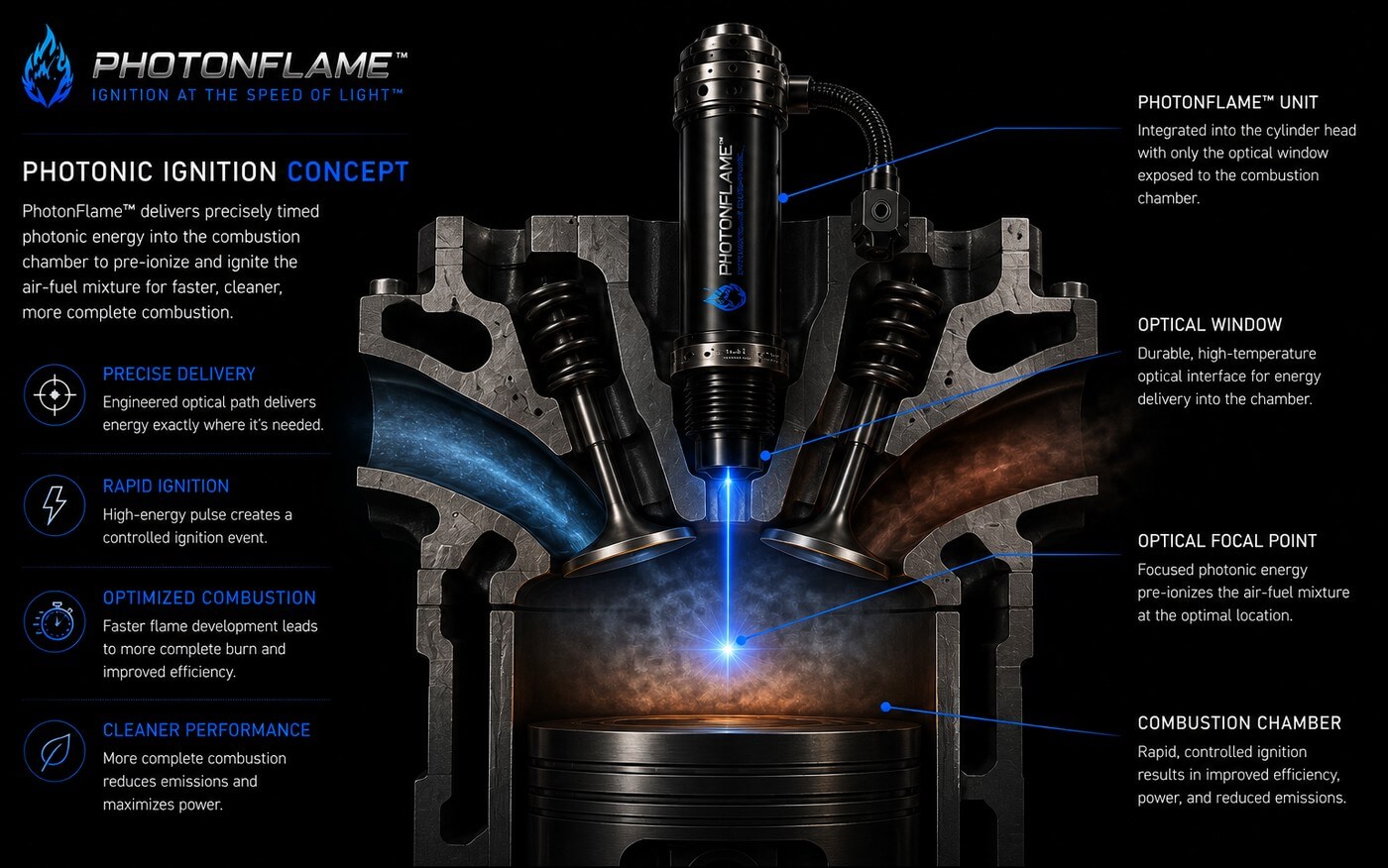
Instead of an electrode and a spark, PHOTONFLAME uses a compact, high-power laser to ignite the fuel-air mixture, with pinpoint precision and none of the wear that eventually degrades a traditional spark plug. The result is a faster, more complete burn, triggered in a fraction of a millisecond, every time the engine fires.

Conceptual cutaway of a PHOTONFLAME unit seated in a cylinder head, illustrating the optical path from the unit's window to the focal point inside the combustion chamber.

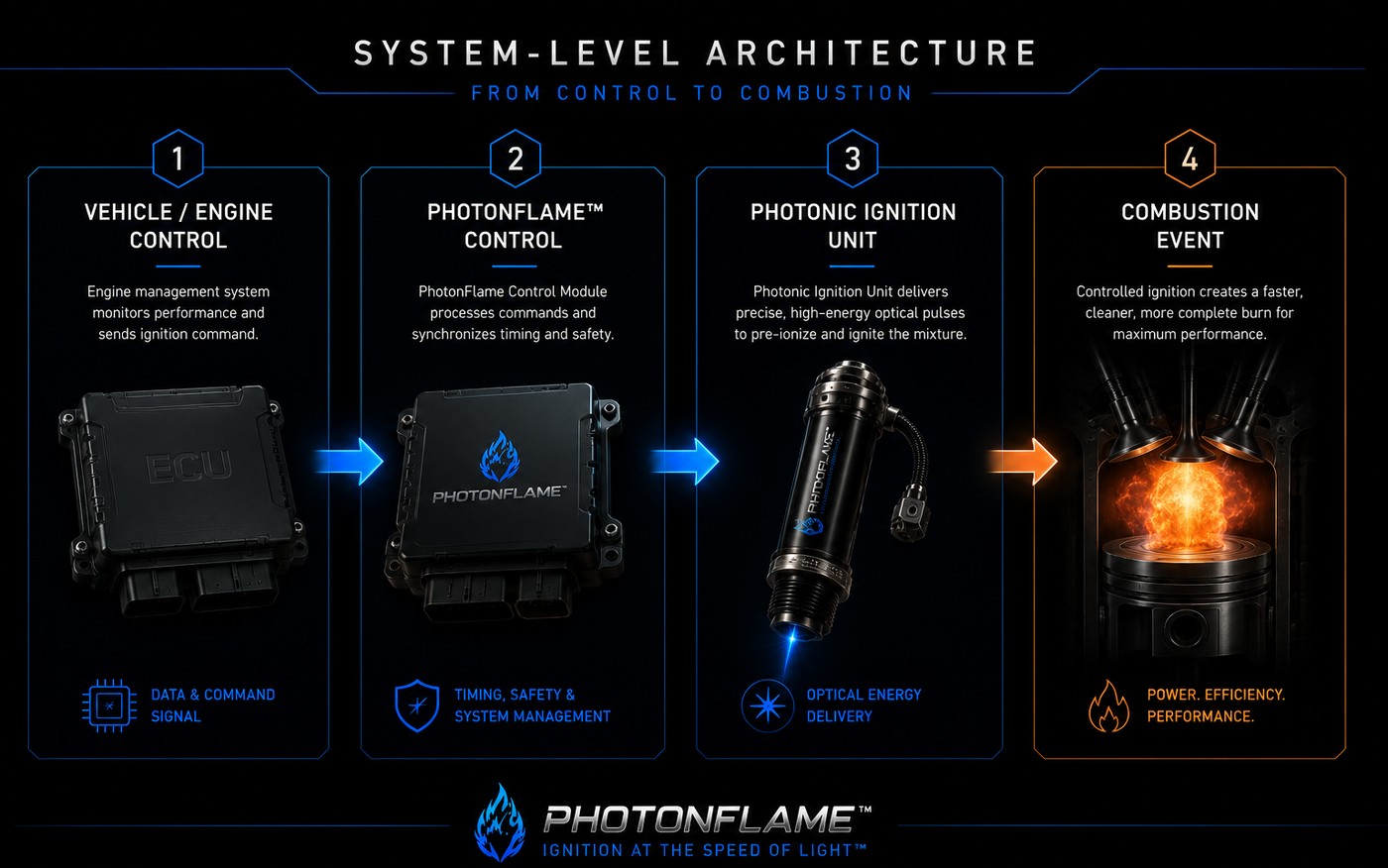
System-level view of the same signal path shown above: engine control electronics trigger the PHOTONFLAME control module, which fires the ignition unit at the commanded moment.
Beyond the qualitative differences, the target engineering specifications point to a measurable performance gap: faster ignition, tighter timing control, and no wear-driven degradation over time.
| Metric | PHOTONFLAME | Conventional Spark |
|---|---|---|
| Ignition latency | <1 ms | 2–5 ms typical |
| Timing precision | ±0.11° crank angle | ±1–3° typical variability |
| Efficiency gain potential | 10–15% | Baseline efficiency |
| Pressure tolerance | Up to 300 bar | 100–150 bar typical limit |
| Electrode wear | Zero | Wear, fouling & gap degradation |
Target specifications reflect PHOTONFLAME’s engineering design goals for its photonic ignition platform, currently under prototype development. These figures are for informational purposes only, are subject to change as development progresses, and are not a guarantee of future performance. Patent applications pending.

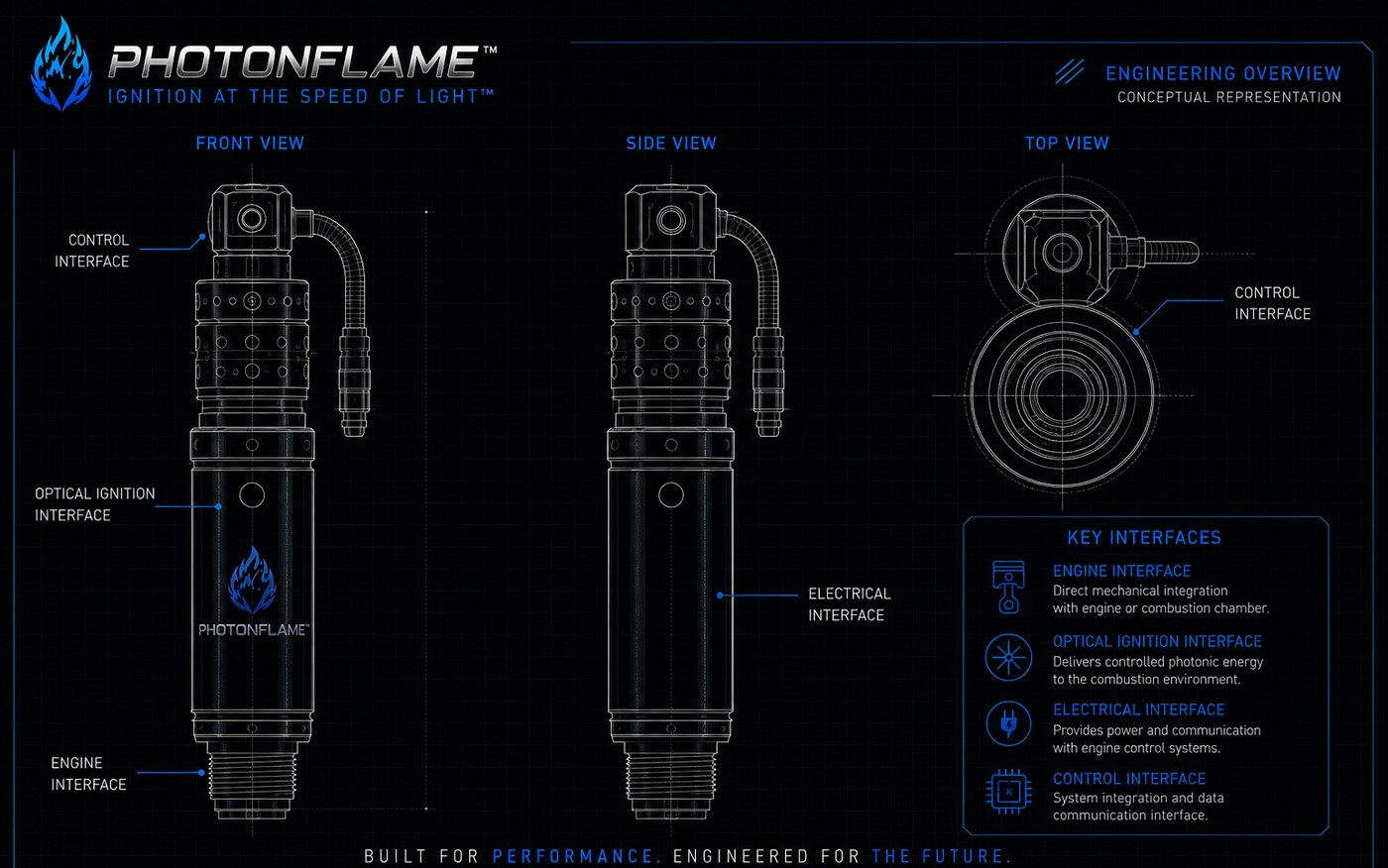
Engineering overview of the target unit design, showing the four key interfaces: engine (mechanical), optical (ignition), electrical (power), and control (system integration).
Conceptual rendering of PHOTONFLAME's target integration approach. The platform remains in prototype development; actual fit and form factor are subject to change. Patent applications pending.
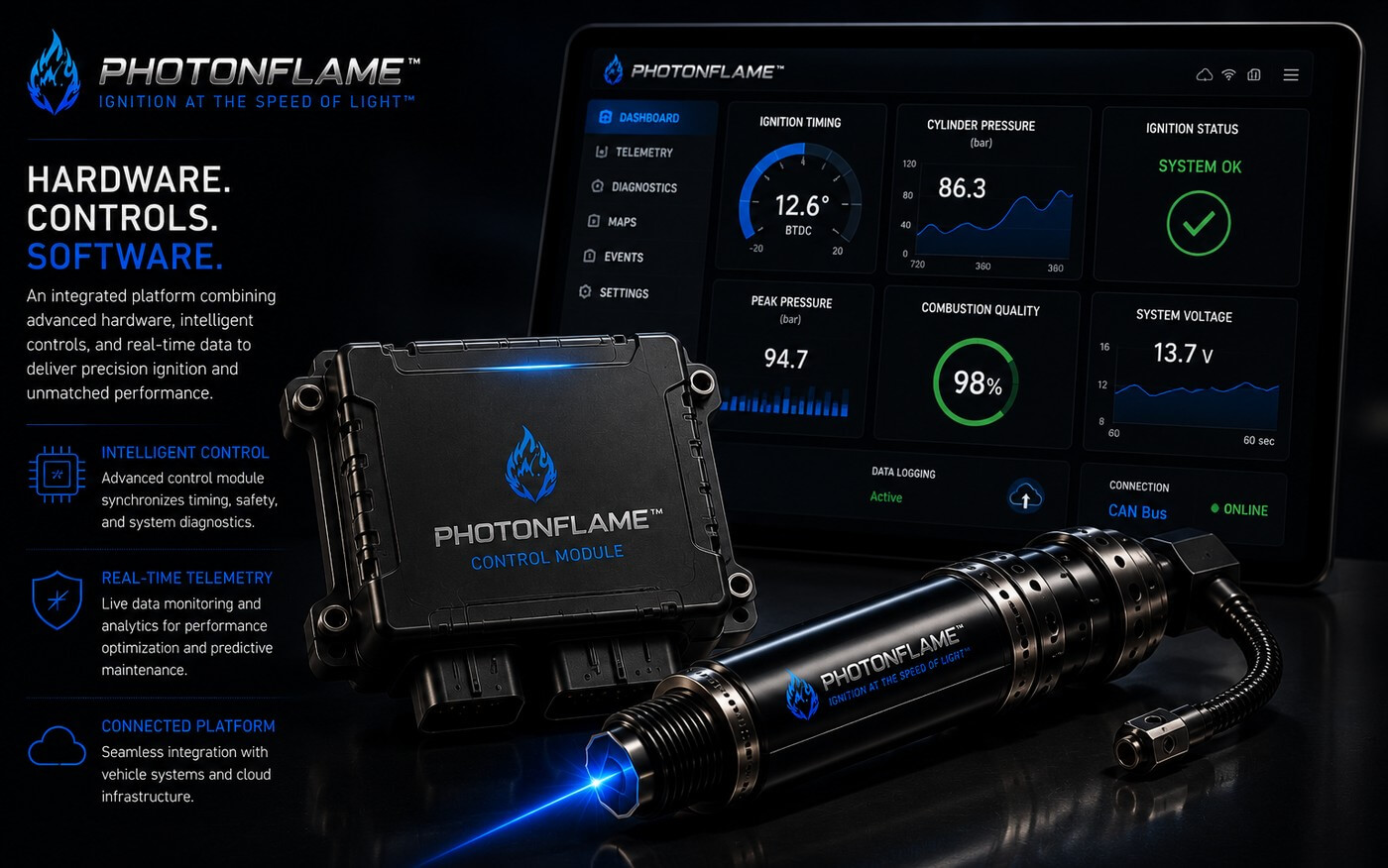
Because ignition timing is controlled photonically rather than mechanically, PHOTONFLAME's control electronics can report on every ignition event in real time — timing, cylinder pressure, and system health — targeted for direct integration with an engine's existing control and telemetry systems.

Concept view of PHOTONFLAME's control & telemetry software, targeting real-time ignition timing, cylinder pressure, and system-health reporting over a standard CAN bus connection.
Our plan moves deliberately: prove the technology works, prove it works in real engines under real conditions, then scale it into engines built by others.
Build and bench/dyno-test a fully working prototype over a structured 32-week program, confirming the technology performs as designed before it goes near a real engine.
Put PHOTONFLAME into the hands of the motorsports, industrial, and aerospace partners already engaged with us, testing it in real engines, under real operating conditions.
Begin deploying ignition systems directly, and license the technology to engine manufacturers and Tier-1 suppliers so it can be built into new engine programs at scale.
As PHOTONFLAME is built into production engines, we earn ongoing per-unit royalties, plus recurring revenue from fleet management and diagnostics software.

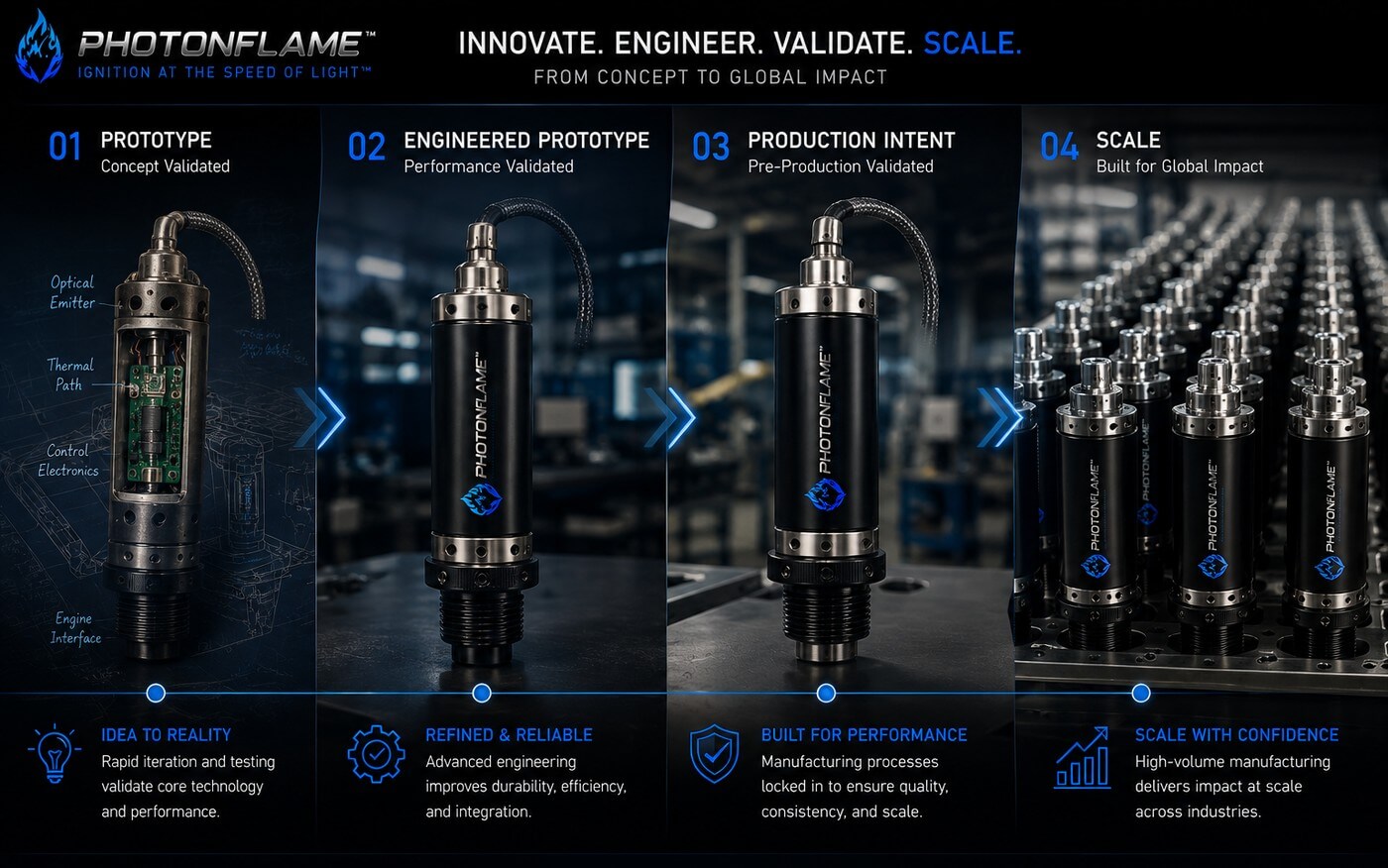
The same four stages above, shown against the unit's evolving hardware — from an early bench prototype through to a production-representative design ready to scale.
PHOTONFLAME’s commercialization strategy is intentionally phased, starting in high-performance motorsports and industrial applications, where the technology can be proven fastest, before expanding into the far larger automotive, energy, and aerospace markets.
$187B+
Total Addressable Market
Global, across motorsports, automotive, industrial, energy, and aerospace
$39B+
Serviceable Available Market
Next 10 years, within PHOTONFLAME’s phased commercialization strategy
$3B+
Serviceable Obtainable Market
Next 10 years, management’s estimate of realistic capture
| Target Market | TAM | SAM (10 yr) | SOM (10 yr) |
|---|---|---|---|
| Motorsports | $8B+ | $2.1B+ | $250M+ |
| Automotive OEM & Performance | $72B+ | $12B+ | $1B+ |
| Industrial Engines | $46B+ | $9B+ | $750M+ |
| Energy & Natural Gas | $28B+ | $6B+ | $500M+ |
| Aerospace & Defense | $21B+ | $5B+ | $400M+ |
| Emerging & Adjacent Markets | $12B+ | $5B+ | $250M+ |
Market estimates reflect PHOTONFLAME management’s analysis of publicly available industry research and are intended to provide directional market sizing based on the Company’s target applications. TAM, SAM, and SOM figures are management estimates only, are not guarantees of future results, and supporting methodology is available upon request.

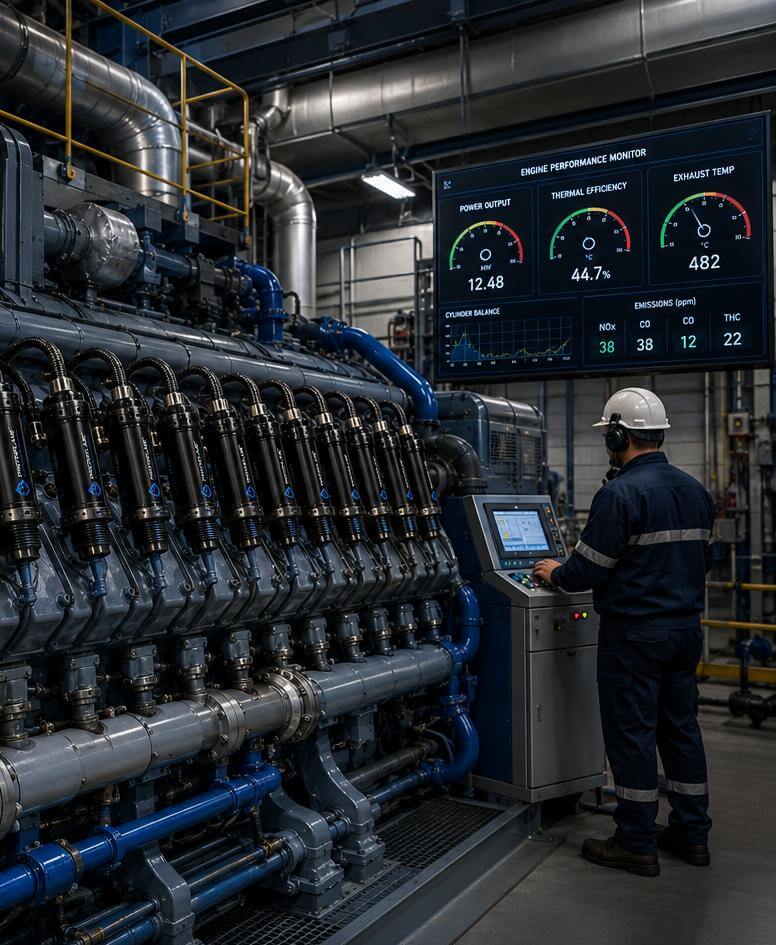
Target industrial application: large-bore natural-gas engines, where faster and more complete combustion supports lower emissions and higher thermal efficiency.

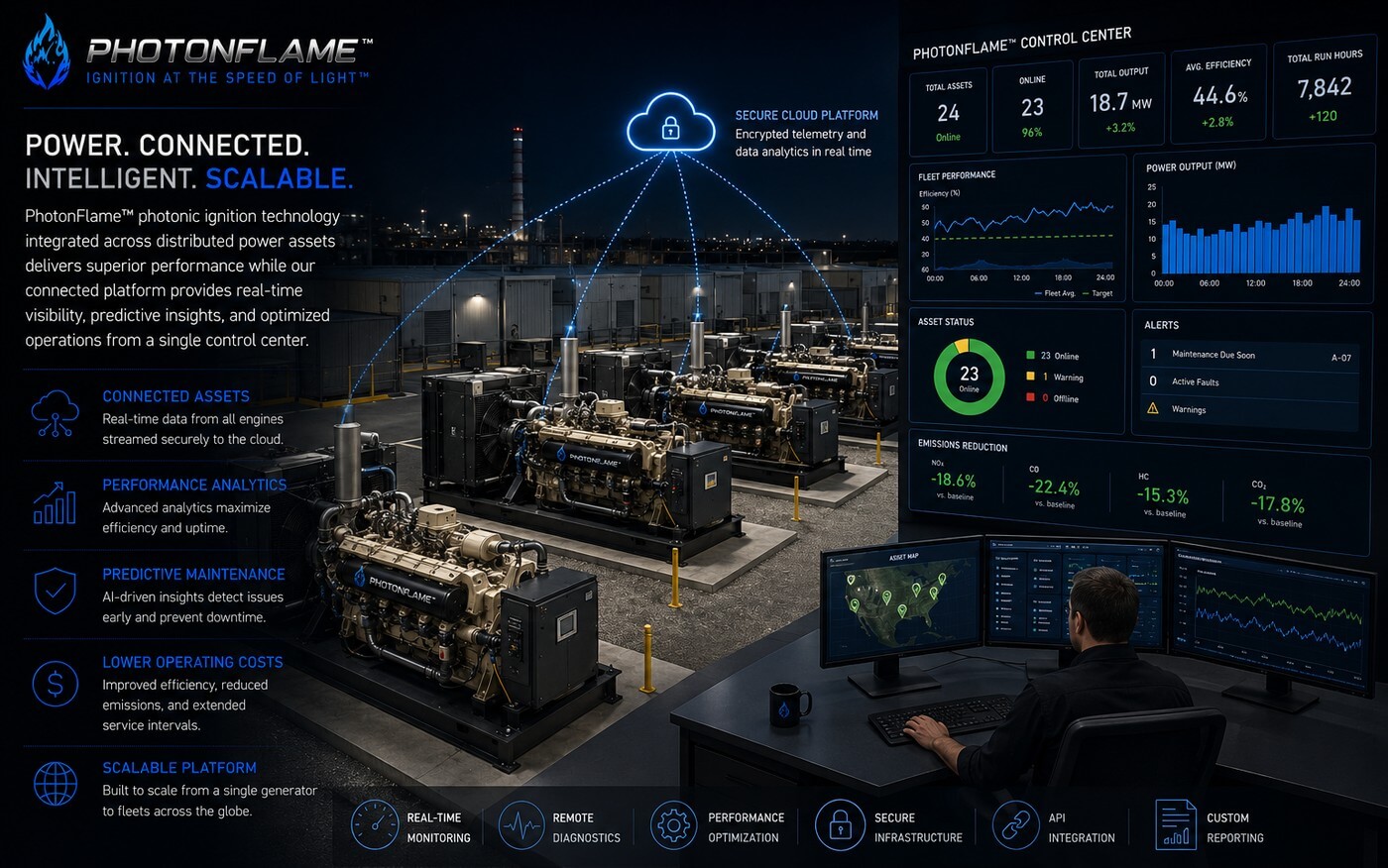
Concept fleet-management view for connected, PHOTONFLAME-equipped assets — the recurring software layer behind the royalty and diagnostics revenue described above.
Throughout my conversations with the PHOTONFLAME team, I have been impressed by their vision, professionalism, and dedication to building something that creates value for both the racing community and their investors.
Colton Collins, ARCA Driver
Signed letter of support from Colton Collins (ARCA/NASCAR Driver) supporting future R&D, validation, and potential motorsports pathways within the NASCAR ecosystem.
Active technical engagement and discussions across the NHRA community.
Soft letter of intent supporting future collaboration.
Active technical engagement including kerosene ignition applications and validation pathways.
Partnership discussions underway with a leading natural gas compression provider, under a mutual NDA.
Letter of intent prepared for participation, contingent upon lead investor confirmation.
Investment application submitted and under review.
Engaged with the Office of the Governor of Texas, the Texas Department of Economic Development, and the Dallas Regional Chamber to relocate headquarters and operations to the Dallas–Fort Worth area.
Three non-provisional patent filings covering core photonic ignition architecture and related systems, filed January 11, 2026.
Support reflects an individual driver's endorsement and does not constitute an endorsement by NASCAR, ARCA, or their affiliates.

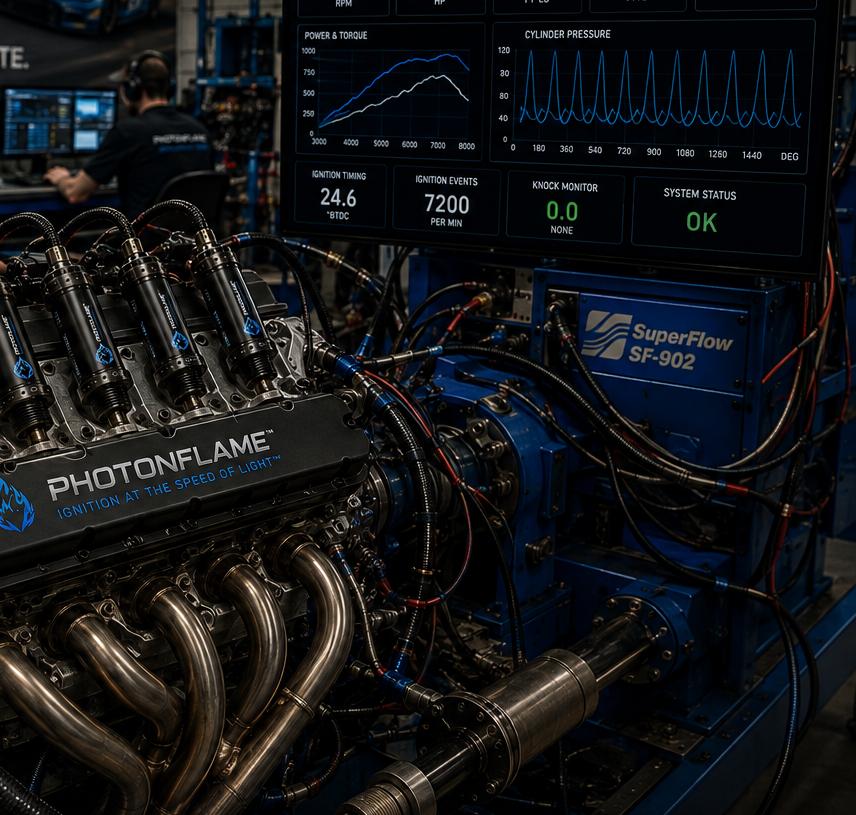
Target bench/dyno validation setup for the prototype & validation program described above — instrumented for engine speed, power, torque, and ignition timing.

Founder & CEO
John is the inventor and technical founder behind PHOTONFLAME, drawing on more than twenty years of independent research across combustion, photonics, lasers, and engine technology. A U.S. Marine Corps veteran, he leads technology, IP, product vision, and capital strategy.

Co-Founder & COO
Justin brings more than twenty years of experience in operations and workforce leadership, overseeing compliance, SOPs, and scheduling across field operations. He leads the operational execution and commercialization infrastructure PHOTONFLAME needs to scale.
John Gibson’s fascination with lasers started with a laser pointer and grew into a personal invention, a biometric-controlled photonic lighter, before it ever touched an engine. That changed while he was helping a friend work on a misfiring cylinder: if focused light carried enough energy to ignite something from across a room, why couldn’t that same principle be engineered into a spark plug? Digging into the physics, John found laser ignition wasn’t new. Researchers had proven it worked in engines as far back as the late 1970s. What had never caught up were the lasers, electronics, and manufacturing needed to make it practical. That gap is what PHOTONFLAME exists to close.
It started with curiosity about a blue laser, and collided with a misfiring cylinder in a friend’s car. Once I saw the connection, I couldn’t stop asking the next question.
John Gibson, Founder & CEO
Laser and photonic ignition have been researched for decades, but practical commercialization has historically been limited by cost, packaging, reliability, thermal management, power electronics, and manufacturing challenges. PHOTONFLAME is focused on integrating modern photonics, electronics, and software into a commercially viable ignition platform, capabilities that have only recently become practical to combine at this scale and cost.
Electrification will continue to play an important role in transportation and energy, but hundreds of millions of internal combustion engines remain in operation worldwide and are expected to keep serving critical roles for decades, in motorsports, heavy-duty transportation, industrial equipment, natural gas compression, distributed power generation, marine, aviation, and defense. PHOTONFLAME isn’t competing against electrification; it’s focused on improving the performance, efficiency, and reliability of the combustion systems that will keep powering those industries, including compatibility with alternative and cleaner fuels.
PHOTONFLAME is a pre-revenue company currently advancing prototype development along a structured 32-week engineering plan. Funding is intended to support engineering, prototype construction, testing, validation, intellectual property expansion, and early commercialization activities.
The long-term business model spans hardware sales, OEM licensing, strategic partnerships, per-unit production royalties, and recurring software revenue from fleet management, diagnostics, and biometric authorization services, giving PHOTONFLAME multiple independent paths to revenue rather than reliance on a single market or customer.
PHOTONFLAME’s platform is being designed to support biometric authentication for authorized system activation where appropriate. This is intended to provide an additional layer of operational security while enabling future fleet management, equipment authorization, and theft-deterrence applications across commercial, industrial, and specialty use cases.
PHOTONFLAME has filed multiple non-provisional patent applications covering its core photonic ignition architecture and related systems, and continues to expand its intellectual property portfolio as development progresses.
Before running any formal offering, PHOTONFLAME is gauging investor interest through a Testing the Waters (TTW) campaign, no money or commitment required. See the phased raise structure, use of funds, market sizing, and how to reserve your spot on our TTW page.
See Raise Details & Express Your InterestThis is not an offer to sell or a solicitation of an offer to buy securities. Before any offering, PHOTONFLAME may conduct a Testing the Waters campaign under Reg CF to gauge interest; no offer or solicitation will be made until PHOTONFLAME files a Form C with the SEC and the offering is live on IPO Wallet. No offering is open yet, and no money or other consideration is being solicited or accepted at this time; if any were sent it would not be accepted. Any indication of interest expressed here or during a Testing the Waters campaign is non-binding and revocable, involves no commitment or payment of any kind, and does not obligate PHOTONFLAME or IPO Wallet in any way. Full offering terms will be published only once PHOTONFLAME's Form C is filed and the offering is live on IPO Wallet. Investing in early-stage private companies involves significant risk, including total loss of investment; see the full risk disclosures in the site footer.
Questions about the technology, partnerships, press, or our future fundraising plans: reach the team directly. Messages are routed to john@photonflametech.com.
Prefer to just talk? Click "Schedule a Meeting" in the menu above to grab a time directly on John's calendar, no back-and-forth required.